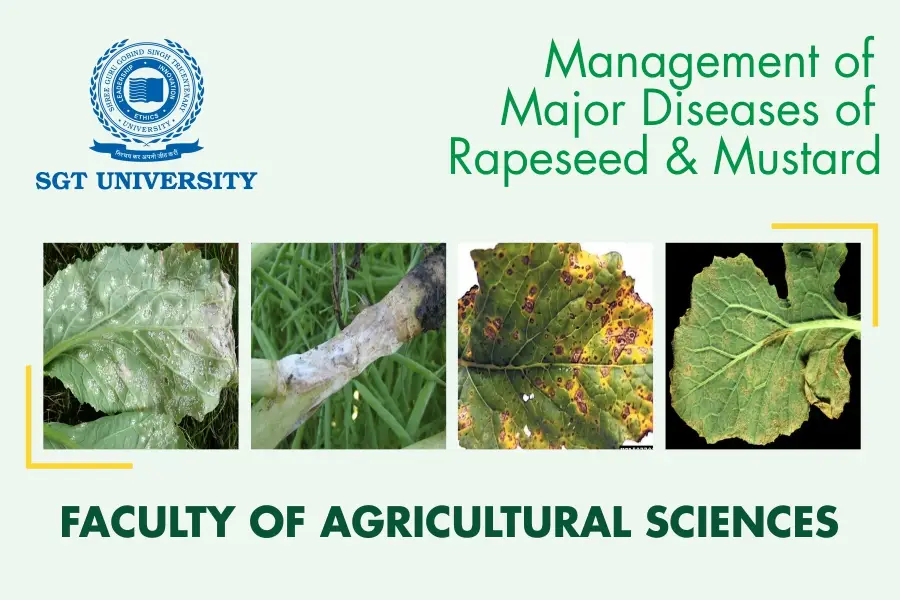
Rapeseed and Mustard are the essential oilseed crops of India. The yield of the crops is adversely affected if proper plant protection measures are not followed.
Rapeseed and Mustard are the essential oilseed crops of India. The yield of the crops is adversely affected if proper plant protection measures are not followed. The significant diseases infesting mustard in northern states are Alternaria Blight, White Rust, Sclerotinia Rot, and Downey Mildew.
The disease is caused by the fungus Alternaria brassicae, favouring high atmospheric humidity and low temperature (20-23 degrees Celcius). Early symptoms appear on lower leaves at 40-45 days after sowing during the first week of November as greyish black circular spots. At later stages, the development of concentric rings on leaves becomes visible, leading to the blightening phase. The disease intensified at the 75% flowering stage. Black spots become visible on stems and pods. When spots develop on pods, it results in shrinking and drying of pods and causes a reduction in seed yield and oil content.
White rust or white blister disease is caused by the fungus Albugo candida, consisting of the leaf and systemic phases. The leaf phase of the disease is characterized by the development of white or creamy yellow pustules of about 1-2 mm in size, first on the lower leaf surface 40-45 days after sowing. The systemic phase of the disease is characterized by hypertrophy and hyperplasia of the affected racemes, followed by malformed appearances of the entire inflorescence, referred to as the staghead phase. Reduced sunlight (2-6h/day) concomitant with high rainfall (100-161 mm), fluctuation of temperatures between 60C-250C with a relative humidity of 70-73% during the flowering period favours the development of the disease.
Sclerotinia rot or Sclerotinia stem rot disease is caused by Sclerotinia sclerotiorum (Lib) de Bary. It commonly occurs during January-February at the flowering stage, favoured by low temperature and high atmospheric humidity. Symptoms arise as water-soaked spots on the stem, later covered with cottony white growth. The affected stem becomes bleached, and eventually, the tissues shred, which leads to the stem’s girdling, premature ripening, and lodging of plants. Hard sclerotia are formed inside the stem. The symptoms also appear on leaves and pods in the form of whitish patches. Sclerotinia survives in the soil for up to 4-5 years as sclerotia.
The fungus Hyaloperonospora parasitica causes this disease. Symptoms appear as white cottony growth on the lower surface of cotyledons and true leaves. The upper surface of leaves turns yellow, and eventually, the leaves dry and fall. The mixed infection of downy mildew and white rust leads to distorted inflorescence covered by white cottony growth of downy mildew pathogen known as a staghead phase. These branches do not bear siliqua resulting in low seed yield. The fungus is soil-borne and may persist in the soil for 5- 10 years.
For managing significant diseases of mustard, integrated diseases management practices as given below to be followed: