

What Delhi NCR's Air Does to Your Lungs: AQI Levels, PM2.5 and How to Protect Yourself
Updated on: October 22, 2026
Introduction
Every year from October, the sky over Delhi NCR turns grey and the Air Quality Index (AQI) climbs into the Poor, Very Poor and sometimes Severe bands. Most residents know the air is bad. Fewer know what the AQI numbers mean for their health, which particles do the damage, or which of the many masks, purifiers and remedies on sale actually help.
This guide explains it in plain language, using the Central Pollution Control Board's (CPCB) own definitions and the health advice issued by India's Ministry of Health and Family Welfare. It is general information and does not replace advice from your doctor.
The Short Answer
Quick answer: Delhi NCR's winter air is dominated by fine particles called PM2.5, which are about 30 times smaller than the width of a human hair and pose the greatest health risk of all particles because they can get deep into the lungs. In the short term, they cause coughing, wheezing, chest discomfort and irritation of the eyes, nose and throat. Long-term exposure is linked to chronic lung and heart disease, lung cancer and premature death (MoHFW). The CPCB AQI tells you how worried to be: from Poor (201–300), prolonged exposure can cause breathing discomfort for everyone, and at Severe (401–500) even healthy people may be affected. Children, older adults, pregnant women, people with asthma, COPD or heart disease, and outdoor workers face the highest risk. What helps: checking the AQI, avoiding outdoor exercise on bad days, a well-fitted N95 or N99 mask outdoors, and keeping indoor air clean. What does not: cloth or paper masks, scarves, and ozone-generating purifiers.
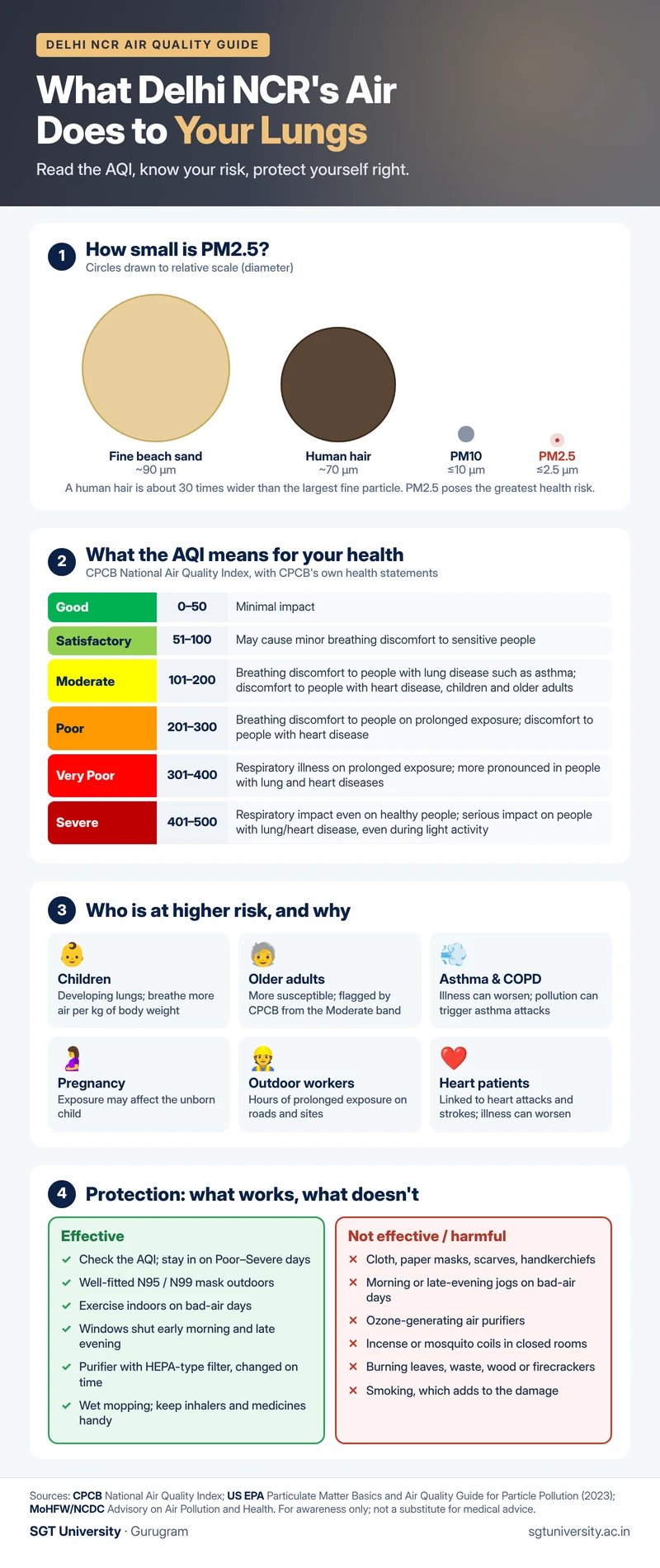
Table of Contents
- The Short Answer
- What Is PM2.5, and Why Is It So Harmful?
- What Polluted Air Does to Your Lungs and Heart
- AQI Levels Explained: What Each CPCB Band Means
- How Delhi NCR's Air Compares with the Standards
- Who Is Most at Risk, and Why
- What Protects You and What Does Not
- Symptoms That Need a Doctor
- Advice for Schools, Parents and RWAs
- Lung and Chest Care at SGT Hospital
- Key Takeaways
- FAQs
- Sources
What Is PM2.5, and Why Is It So Harmful?
PM stands for particulate matter: tiny particles of dust, smoke, soot and droplets suspended in the air. The US Environmental Protection Agency (EPA) defines PM2.5 as fine inhalable particles with diameters generally 2.5 micrometres and smaller, and PM10 as inhalable particles generally 10 micrometres and smaller (US EPA).
| Particle or object | Approximate diameter | Compared with PM2.5 |
|---|---|---|
| Fine beach sand | 90 micrometres | About 36 times wider |
| Average human hair | 70 micrometres | About 30 times wider |
| PM10 (coarse inhalable particles) | 10 micrometres or smaller | Up to 4 times wider |
| PM2.5 (fine particles) | 2.5 micrometres or smaller | — |
Source: US EPA, Particulate Matter (PM) Basics, including its particle-size comparison graphic. The EPA notes that an average human hair is about 70 micrometres in diameter, making it 30 times larger than the largest fine particle.
Their size is the problem. The EPA explains that some particles smaller than 10 micrometres can get deep into the lungs and some may even get into the bloodstream, and that fine particles (PM2.5) pose the greatest risk to health (US EPA). That is why PM2.5 readings matter so much on Delhi NCR's worst days.
What Polluted Air Does to Your Lungs and Heart
India's Ministry of Health and Family Welfare, through its National Programme on Climate Change and Human Health, describes two kinds of harm (MoHFW advisory on air pollution and health):
| Type of exposure | Possible health effects |
|---|---|
| Short term, high exposure (days of bad air) | Irritation of the eyes, nose and throat; coughing; wheezing; chest discomfort; acute upper respiratory infections |
| Long term (months and years) | Chronic respiratory and cardiovascular illness, lung cancer and premature death |
The US EPA adds that particle pollution can reduce lung function and trigger asthma attacks, heart attacks and strokes, and is linked to early death in people with heart or lung disease (US EPA Air Quality Guide for Particle Pollution). In other words, polluted air is not only a lung problem; it affects the heart and blood vessels too.
AQI Levels Explained: What Each CPCB Band Means
The AQI converts readings of eight pollutants (PM10, PM2.5, nitrogen dioxide, sulphur dioxide, carbon monoxide, ozone, ammonia and lead) into a single number from 0 to 500. The CPCB places that number in one of six bands and attaches a health statement to each. The statements below are the CPCB's own.
| AQI category | AQI range | PM2.5 (24-hr, µg/m³) | CPCB health impact |
|---|---|---|---|
| Good | 0–50 | 0–30 | Minimal impact |
| Satisfactory | 51–100 | 31–60 | May cause minor breathing discomfort to sensitive people |
| Moderate | 101–200 | 61–90 | May cause breathing discomfort to people with lung disease such as asthma, and discomfort to people with heart disease, children and older adults |
| Poor | 201–300 | 91–120 | May cause breathing discomfort to people on prolonged exposure, and discomfort to people with heart disease |
| Very Poor | 301–400 | 121–250 | May cause respiratory illness to people on prolonged exposure; effect may be more pronounced in people with lung and heart diseases |
| Severe | 401–500 | Above 250 | May cause respiratory impact even on healthy people, and serious health impacts on people with lung or heart disease; effects may be felt even during light physical activity |
Source: CPCB National Air Quality Index, categories, PM2.5 breakpoints and associated health impacts, as published on the Government of India's Arthapedia (Indian Economic Service). Check live readings on the CPCB AQI dashboard.
In Delhi NCR, the Commission for Air Quality Management (CAQM) uses these bands to trigger the Graded Response Action Plan (GRAP), with restrictions that tighten as the AQI moves from Poor to Very Poor and Severe (CAQM). When you hear that a GRAP stage has been invoked, it means the air has crossed one of these thresholds.
How Delhi NCR's Air Compares with the Standards
India's National Ambient Air Quality Standard for PM2.5 is 60 micrograms per cubic metre (µg/m³) over 24 hours and 40 µg/m³ as an annual average (CPCB NAAQS); 60 µg/m³ is also the upper limit of the CPCB's Satisfactory band. The World Health Organization's 2021 Air Quality Guidelines are stricter: a 24-hour PM2.5 level of 15 µg/m³ and an annual average of 5 µg/m³ (WHO Global Air Quality Guidelines, 2021). On a Severe day in Delhi NCR, PM2.5 is above 250 µg/m³, more than four times the Indian standard and more than 16 times the WHO 24-hour guideline.
Who Is Most at Risk, and Why
Everyone is affected by bad air, but some people are affected sooner and more severely. These six groups should take precautions from lower AQI levels than the general public.
| Group | Why they are at higher risk |
|---|---|
| Children | Their lungs are still developing, and they breathe more air per kilogram of body weight than adults (US EPA). Children under five are named by the health ministry as more susceptible. |
| Older adults | Named by the health ministry as more susceptible, and flagged by the CPCB's own AQI from the Moderate band. |
| People with asthma or COPD | At high risk of their illness getting worse (MoHFW). The CPCB warns of breathing discomfort for people with lung disease such as asthma from the Moderate band, and particle pollution can trigger asthma attacks (US EPA). |
| Pregnant women | Exposure may affect the unborn child (MoHFW). |
| Outdoor workers | Traffic police, construction workers, road sweepers, auto and rickshaw drivers and street vendors face prolonged exposure (MoHFW). |
| People with heart disease | At high risk of their illness getting worse (MoHFW). Particle pollution is linked to heart attacks and strokes (US EPA), and the CPCB flags people with heart disease from the Moderate band. |
Sources: MoHFW/NCDC advisory; US EPA; CPCB AQI health statements. The health ministry also lists low-income households and women exposed to household biomass smoke as vulnerable.
What Protects You and What Does Not
Many products and tips circulate every pollution season. This comparison is based on the health ministry's advisory and the US EPA.
| ✅ Effective | ❌ Not effective or harmful |
|---|---|
| Checking the AQI daily and rescheduling outdoor activity; staying indoors on Poor to Severe days | Judging the air by how the sky looks instead of checking the AQI reading |
| A properly fitted N95 or N99 mask for short periods outdoors, replaced as instructed | Paper masks, handkerchiefs, scarves or cloth masks, which the advisory says are not effective |
| Exercising indoors, or choosing lighter activity, on bad-air days | Walking, jogging or exercising outdoors in the early morning or late evening on Poor to Severe days |
| Keeping doors and windows closed in the morning and late evening; ventilating, if needed, between 12 noon and 4 pm | Opening windows wide in the early morning or late evening |
| An air purifier with suitable (for example HEPA) filters, used as the manufacturer instructs and with regular filter changes; air conditioners on 're-circulate' | Ozone-generating air purifiers, which the advisory says not to use |
| Wet mopping, or vacuuming with a HEPA filter | Dry sweeping that throws dust back into the air |
| Using clean fuels such as gas or electricity for cooking and heating | Burning wood, coal, waste, leaves or crop residue, or burning mosquito coils and incense in closed rooms |
| Keeping prescribed inhalers and medicines readily available if you have asthma, COPD or heart disease | Smoking cigarettes or bidis, which adds to the damage |
Sources: MoHFW/NCDC advisory on air pollution and health; US EPA Air Quality Guide for Particle Pollution.
😷 Getting an N95 mask right
- Choose a mask marked N95 or N99, and buy it from a reliable source.
- It must fit closely around your nose and chin; air leaking around the edges defeats the purpose.
- Follow the manufacturer's instructions and replace it as advised.
- If you have heart or lung disease, ask your doctor which mask is suitable for you.
Symptoms That Need a Doctor
⚠ See a doctor if you notice these, especially if they are getting worse
- Breathlessness
- Giddiness
- Cough that does not settle
- Chest discomfort or pain
- Red, watery or irritated eyes
- For sudden severe breathlessness or chest pain, call 112 or go to the nearest emergency department immediately
Source: MoHFW/NCDC advisory, which also advises vulnerable people to seek medical advice immediately if symptoms worsen.
Advice for Schools, Parents and RWAs
- Schools: check the AQI before outdoor assemblies, sports and physical education, and move them indoors on Poor to Severe days. The health ministry's 2025 advisory includes a separate annexure of advice for school children.
- Parents: keep children with asthma on their prescribed treatment plan, and watch for coughing or wheezing after outdoor play.
- Residents' welfare associations: discourage burning of leaves, garbage and wood in the society, schedule wet sweeping instead of dry sweeping, and share the daily AQI on resident groups.
- Employers of outdoor workers: provide properly fitted N95 masks and rotate shifts where possible on the worst days. The 2025 advisory includes guidance for construction and demolition workers.
Sources: MoHFW letter and updated advisory, 1 November 2025; MoHFW/NCDC advisory.
Lung and Chest Care at SGT Hospital
SGT University in Gurugram runs an associated teaching hospital where patients with breathing problems, asthma, COPD and pollution-related symptoms can be assessed.
Key Takeaways
- PM2.5 particles are about 30 times smaller than the width of a human hair and pose the greatest health risk of all particles.
- Short-term exposure causes coughing, wheezing and irritation; long-term exposure is linked to chronic lung and heart disease and lung cancer.
- From the CPCB's Poor band (201–300), prolonged exposure can affect everyone; at Severe (401–500), even healthy people may be affected.
- Children, older adults, pregnant women, people with asthma, COPD or heart disease, and outdoor workers need to act at lower AQI levels.
- Well-fitted N95 or N99 masks and clean indoor air help; cloth masks, scarves and ozone-generating purifiers do not.
- Seek medical advice for breathlessness, chest pain, giddiness or a persistent cough.
This article is for general information and awareness. It is not a substitute for medical advice, diagnosis or treatment. Always consult a qualified doctor about your own health.
FAQs
Q1. How does Delhi NCR air pollution affect the lungs?
According to the US EPA, some particles smaller than 10 micrometres can get deep into the
lungs and some may even enter the bloodstream, with fine PM2.5 particles posing the greatest
risk. According to India's Ministry of Health and Family Welfare, short exposure to high
pollution can cause irritation of the eyes, nose and throat, coughing, wheezing, chest
discomfort and respiratory infections, while long-term exposure is linked to chronic
respiratory and heart disease, lung cancer and premature death.
Q2. What do AQI levels mean in India?
India uses the CPCB National Air Quality Index, which has six bands: Good (0–50),
Satisfactory (51–100), Moderate (101–200), Poor (201–300), Very Poor (301–400) and Severe
(401–500). Each band carries a health statement. For example, at Poor, people on prolonged
exposure may feel breathing discomfort; at Severe, even healthy people may have respiratory
effects.
Q3. What is PM2.5?
PM2.5 refers to fine inhalable particles with diameters generally 2.5 micrometres and
smaller. The US EPA notes that an average human hair is about 70 micrometres across, about
30 times larger than the largest fine particle.
Q4. Which AQI level is unsafe?
There is no single cut-off that is safe for everyone. Under the CPCB index, sensitive people
may feel effects from the Satisfactory band (51–100), people with lung or heart disease,
children and older adults from Moderate (101–200), and everyone on prolonged exposure from
Poor (201–300) upwards. The health ministry advises staying indoors on Poor to Severe days.
Q5. Does an N95 mask protect against pollution?
A properly fitted N95 or N99 mask can reduce exposure during short periods outdoors,
according to the health ministry's advisory. Paper masks, handkerchiefs, scarves and cloth
masks are not effective against fine particles. A mask works only if it fits closely, so
follow the instructions and replace it as advised.
Q6. Do air purifiers help?
Air purifiers with suitable filters, such as HEPA filters, can lower indoor particle levels
when used according to the manufacturer's instructions with regular filter replacement. Do
not use air purifiers that generate ozone, which the health ministry's advisory specifically
warns against.
Q7. Is it safe to go for a morning walk when the AQI is poor?
The health ministry advises against walking, jogging or exercising outdoors in the early
morning or late evening on days when the AQI is Poor to Severe. On such days, exercise
indoors or choose a less intense activity.
Q8. Who is most at risk from air pollution?
Children, older adults, pregnant women, people with asthma, COPD or other lung disease,
people with heart disease, and outdoor workers such as traffic police, construction workers
and street vendors face higher risk, according to the health ministry and the US EPA.
Q9. When should I see a doctor for pollution-related symptoms?
Seek medical advice if you notice breathlessness, giddiness, persistent cough, chest
discomfort or pain, or red, watery eyes, especially if symptoms are getting worse. People
with asthma, COPD or heart disease should keep their prescribed medicines readily available.
Q10. Where can I check the AQI in Delhi NCR?
Use the Central Pollution Control Board's official AQI dashboard or its SAMEER mobile app,
which show the National Air Quality Index for monitoring stations across Delhi NCR.
Sources
- Central Pollution Control Board. National Air Quality Index: categories, breakpoints and associated health impacts (via Government of India, Arthapedia).
- Ministry of Health and Family Welfare, National Programme on Climate Change and Human Health / NCDC. Advisory on air pollution and health.
- Ministry of Health and Family Welfare. D.O. letter and updated Advisory on Air Pollution and Health. 1 November 2025.
- US Environmental Protection Agency. Particulate Matter (PM) Basics.
- US Environmental Protection Agency. Air Quality Guide for Particle Pollution (EPA-452/F-23-002). February 2023.
- Central Pollution Control Board. National Ambient Air Quality Standards. 2009.
- World Health Organization. WHO Global Air Quality Guidelines. 2021.
- Commission for Air Quality Management in NCR and Adjoining Areas. Graded Response Action Plan.
- Central Pollution Control Board. Live AQI dashboard.